


If you have used a red dot sight, you might already know that red dot sights sometimes fail due to extreme environments or accidents. Therefore, pairing a red dot sight with iron sights in a co-witness setup allows the iron sights to serve as a backup if the red dot fails.
So today we are going to talk about absolute co-witness vs lower 1/3 co-witness, including their mounting heights, sight pictures, and how to choose a co-witness red dot for your firearm?
Note: This article will introduce the pros and cons of absolute co-witness height and lower 1/3 co-witness height. After reading it, you can know how to choose and install co-witness sights for your firearm.
What Is Red Dot Co-Witness?
Red dot co-witness refers to the alignment between a red dot sight and iron sights, allowing both sighting systems to be viewed through the optic window.
What Is the Difference Between Absolute and Lower 1/3 Co-Witness?
First of all, absolute co-witness and lower 1/3 co-witness are two different red dot mounting height configurations. The height of your red dot sight (the amount of iron sight that occupies the sight picture of your red dot) is the biggest difference between them, so there is nothing inherently better or worse about either setup. Just choose a proper one according to your shooting preferences.
There are 3 popular center heights, as picture 0 shows, the absolute co-witness height is 36mm (1.4 inches); the lower 1/3 co-witness height is 40.4mm (1.6 inches); the other one is 38.1mm(1.5 inches).

If you still feel confused, picture 1 will show you what absolute co-witness and lower 1/3 co-witness look like, thus clearer for you to understand. If you mount the red dot sight in the way that the center dot coincides with the iron sight in the middle, this is called absolute co-witness or 100% co-witness. If you mount the red dot sight higher than the iron sight, and the iron sight appears in the lower 1/3 of the optic window, it is called lower 1/3 co-witness, which provides a less obstructed sight picture.
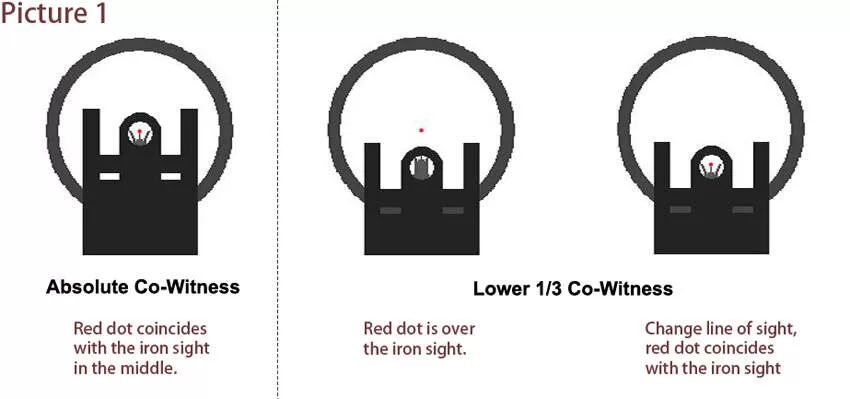
Absolute vs Lower 1/3 Co-Witness: Which Is Better for Your AR-15?
Two different heights, which is better for you? Let’s take the AR-15 platform as an example. For an AR-15 with a fixed iron sight, lower 1/3 co-witness is often preferred because it keeps the iron sights lower in the optic window. However, for an AR-15 with flip-up iron sights, absolute co-witness can also be a practical option, depending on your preferred sight picture and mounting height.
Absolute Co-Witness vs Lower 1/3: Pros and Cons
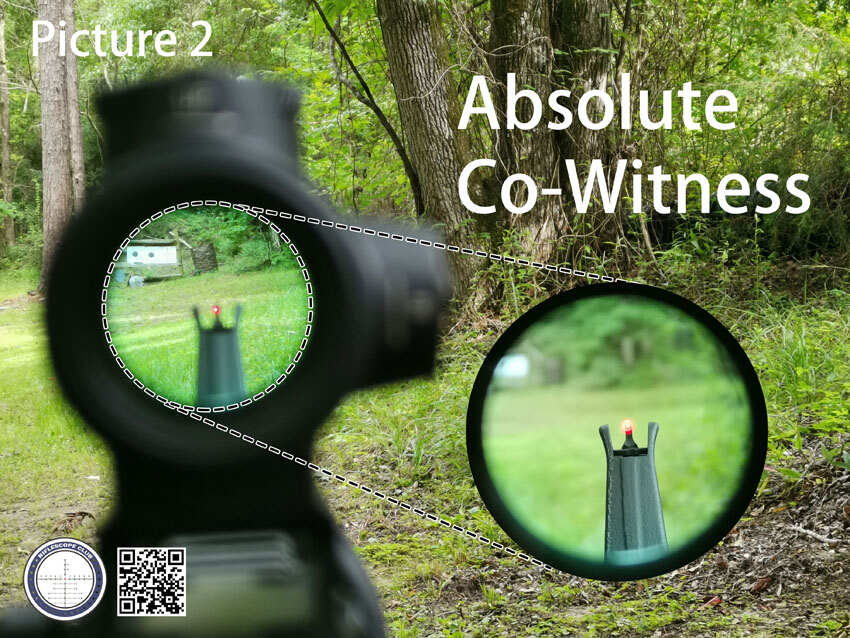
Using absolute co-witness, the iron sights align near the center of the red dot’s sight picture, making the transition to backup iron sights more straightforward, but the iron sights will block part of the field of view.
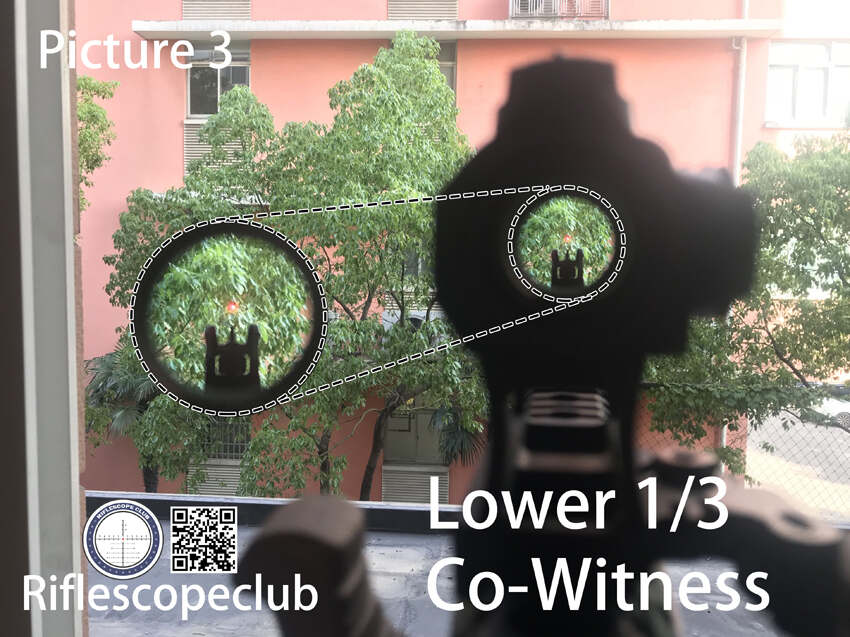
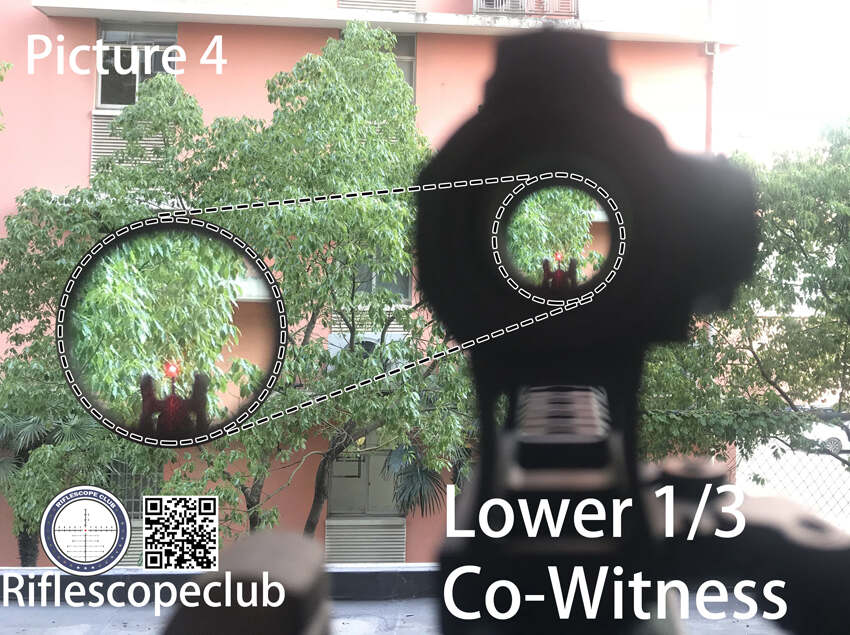
Using lower 1/3 co-witness provides a less obstructed sight picture, but you need to adjust your eye position slightly when switching from the red dot to the iron sights.
Summary
| Absolute co-witness | Lower 1/3 co-witness |
| Pros:
1. Shooters can react faster 2. More accurate Cons: The iron sight will block part of the field of view |
Pros:
1. Wider field of view 2. Less interference Cons: You need to change the line of sight to coincide the red dot with the iron sight |
Therefore, the best advice is to try them both, then make a choice between absolute co-witness and lower 1/3 co-witness according to your shooting preferences, iron sight configuration, and preferred red dot mounting height. Check the Victoptics SRD 1×20 Reflex Sight to explore compatible co-witness mounting options.
Frequently Asked Questions About Red Dot Co-Witness
1. Do You Need to Re-Zero Your Red Dot When Changing Co-Witness Height?
Yes. Changing your red dot mount height can shift the point of impact. Always re-zero your red dot after switching between absolute and lower 1/3 co-witness mounts.
2. Can You Use a Magnifier with a Co-Witness Red Dot?
Yes. A magnifier can work with either co-witness setup, but its optical center height should match the red dot. Choose a compatible magnifier mount or spacer to ensure proper alignment.
3. Does Co-Witness Work the Same Way on AR-15 and AK Rifles?
Not exactly. AR-15 rifles typically have standardized rail heights, while AK platforms use different mounting systems, including side rails and dust-cover mounts. The correct co-witness height depends on the firearm and iron sight configuration.
4. How to Set Up Red Dot Co-Witness with Iron Sights?
How to Set Up Red Dot Co-Witness with Iron Sights?
Get a Free Quote of Sights
Feel free to contact us anytime to get the latest product news and the best prices!