


Have you ever encountered a situation where the point of impact of each shot landed in a different location during the use of a scope? Many people blame this on technical issues or scope mounting problems, but in reality it’s more likely to be due to parallax.
What is parallax?
Wikipedia explains parallax as the difference in direction that results from looking at the same target from two points that are a certain distance apart. What is parallax in a scope? Let’s take a simple example to make it easier to understand.
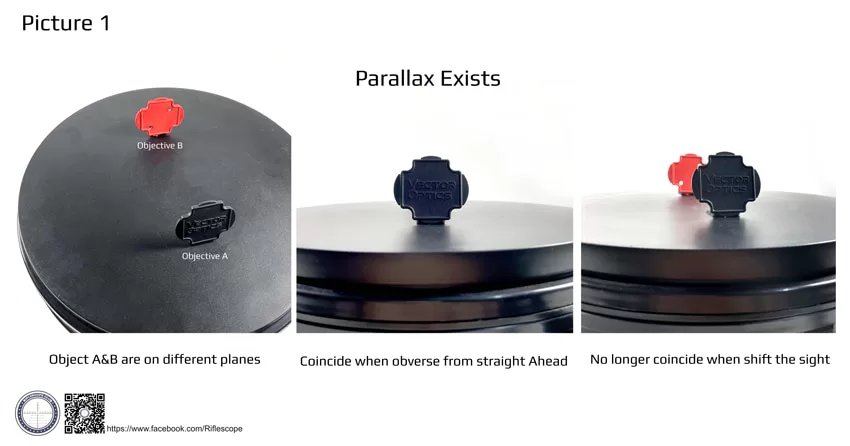
As shown in Picture 1, when two objects are placed on different planes, object A can completely cover object B when viewed from directly in front, but with a slight change in viewing angle, object A and object B no longer coincide. This is due to the presence of parallax.
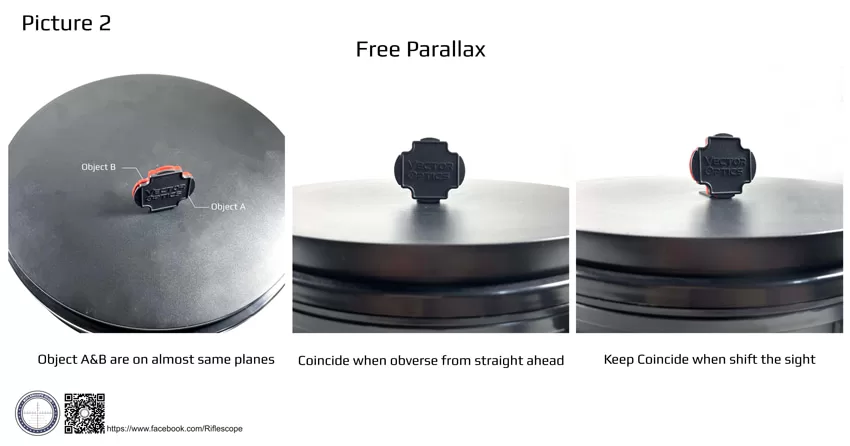
In Picture 2, the two objects sit on nearly the same plane—or even directly on top of each other. When you look straight at them, object A lines up perfectly with object B, and that alignment stays the same even when you change your viewing angle. That’s what “parallax-free” means.
When we move this concept into a riflescope, object A and object B become the reticle and the target image (Picture 3). Parallax appears when the reticle and the image sit on different focal planes. A scope becomes parallax-free when the reticle and the image are brought onto almost the same plane.
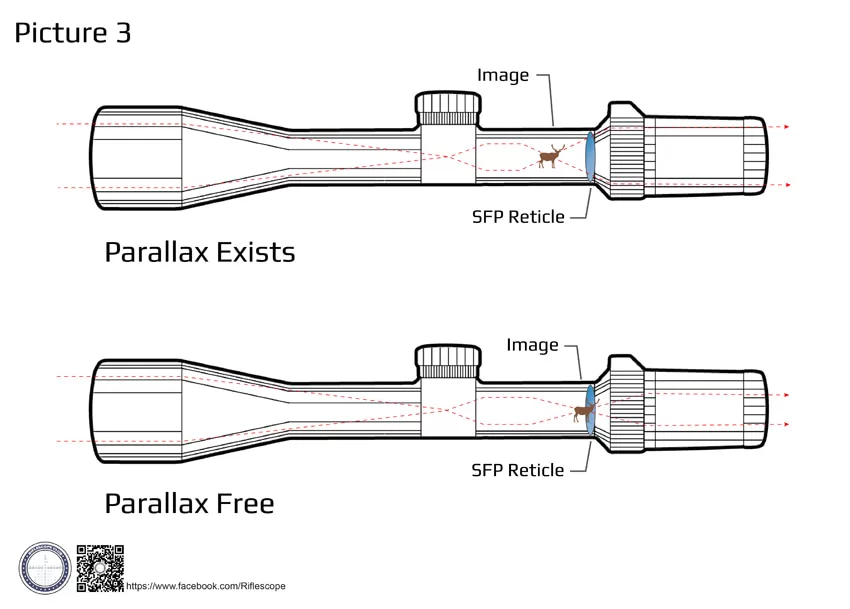
The presence of parallax in the scope has an effect on the accuracy of the shot.
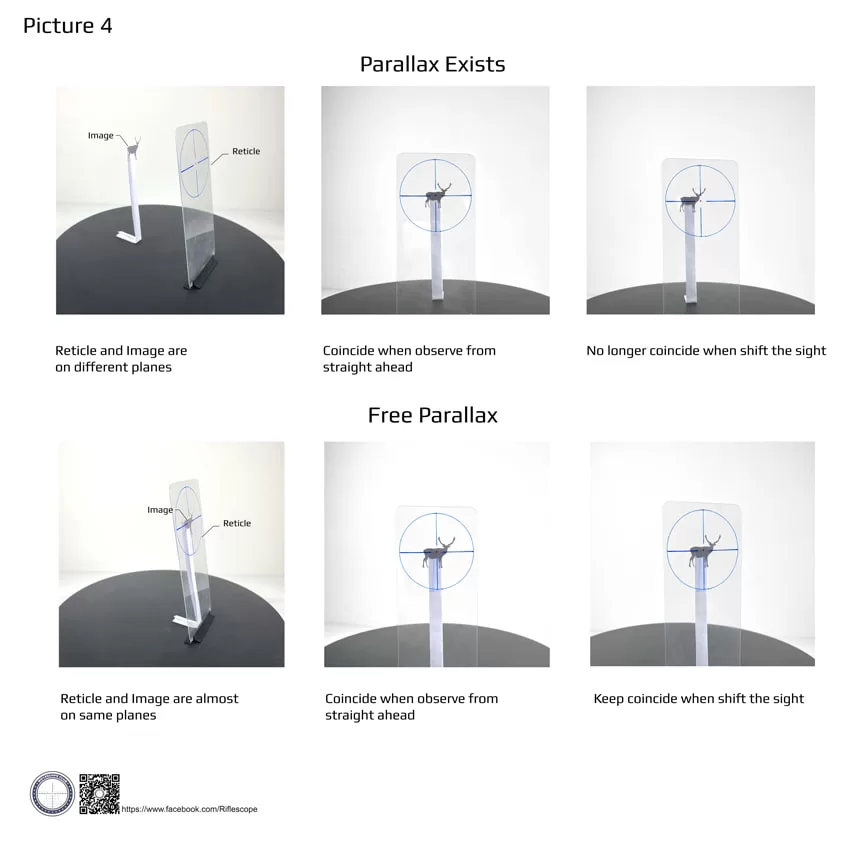
Combining Picture 1 and 2, we replace objects A and B with the reticle and the image (Picture 4). When they sit on different planes, the reticle points at the target only when we look straight through the scope. Once we change the viewing angle or shift our head, the reticle’s center moves, and the point of impact shifts with it.
When the reticle and the image sit on almost the same plane, the aiming point stays locked on the target. It holds steady no matter how we change the angle or move our head, which keeps the point of impact consistent.
So how do we eliminate parallax in the use of scopes?
Theoretically, we can achieve parallax-free by simply adjusting the imaging position to be almost in the same plane as the reticle.

Scopes can be divided into three types based on how they focus. In Picture 5, the left scope is an AO (adjustable objective) model. You change the focus by moving the objective lens. The center scope uses side focus. It adjusts a dedicated internal lens to achieve focus. Both designs allow you to remove parallax. You can learn more about AO and side-focus scopes in this blog.
To keep your shots accurate, you need to remove parallax before each shot. You should also refocus whenever the shooting distance changes.
The third type is a fixed-focus scope. It has no AO ring and no side-focus knob. The factory usually sets it to be parallax free at 50 or 100 yards. Fixed-focus scopes work well for everyday use at low magnifications—such as our bestselling S6 1–6×24 LPVO Rifle Scope. Higher magnification increases the chance of parallax, so fixed-focus designs are not ideal for long-range precision.
For medium- to long-range shooting, we strongly recommend the Victoptics S4 series. It features a smooth side-focus parallax knob like the one shown below. If you pair it with a large side wheel, you get even finer parallax control, giving you a better edge in competition.
VICTOPTICS S4 4-16X44 SFP COYOTE FDE RIFLESCOPE

Victoptics S4 6-24x50 MDL RIFLESCOPE
For wholesale business
Contact us at: https://www.victoptics.com/contact-us/
For retail business
Welcome to visit our retail site: https://vector2007.com/collections/victoptics
Welcome to book a visit to our product showroom!